Beginning with average 401k for a 50 year old, the narrative unfolds in a compelling and distinctive manner, drawing readers into a story that promises to be both engaging and uniquely memorable. As we delve into the world of retirement savings, it becomes increasingly clear that this critical life milestone represents a daunting challenge for many individuals approaching the golden years.
With the average 401k balances fluctuating due to investment returns, withdrawal patterns, and the ever-present threat of inflation and market volatility, achieving financial stability and security has never been more pressing.
The significance of 401k balances for individuals nearing retirement cannot be overstated. A substantial cushion of savings can provide peace of mind, security, and a sense of control as these individuals navigate the complexities of aging and healthcare. Conversely, falling short of their 401k goals can lead to financial difficulties, decreased well-being, and a heightened sense of anxiety. As such, understanding the factors that contribute to average 401k balances is essential for planning, preparation, and ultimately, securing a comfortable financial future.
Understanding the Concept of Average 401k for a 50 Year Old

The average 401k balance for individuals nearing retirement is a crucial metric that can significantly impact their financial stability and security. As a 50-year-old approaches retirement, it’s essential to understand the factors that contribute to the fluctuating 401k average balances and the challenges that come with achieving one’s 401k goals.The significance of 401k average balances for individuals nearing retirement cannot be overstated.
A substantial average balance can ensure a comfortable retirement, while a lower average balance may lead to financial insecurity. The impact of 401k average balances on retirement security is a concern for many individuals, particularly those who are nearing retirement age. A study by the Employee Benefits Research Institute (EBRI) found that 47% of workers aged 45-54 have less than $25,000 in their 401k accounts, highlighting the urgency of this issue.
Factors Contributing to Fluctuating 401k Average Balances
The 401k average balance of a 50-year-old is influenced by various factors, including investment returns, contribution rates, and withdrawal patterns. Investment returns play a crucial role in determining the 401k average balance. The returns on investments can either increase or decrease the 401k balance, depending on market fluctuations. According to a study by Charles Schwab, the S&P 500 index averaged a return of 7% per year from 1990 to 2020, which can significantly impact the 401k balance.
Contribution rates are another critical factor affecting the 401k average balance. Regular contributions can help build up the balance over time, while inconsistent or lower contribution rates can slow down the growth of the balance. Research by Fidelity Investments found that increasing contribution rates by 1% can lead to a 10% increase in the 401k balance over a 10-year period.
Withdrawal patterns also impact the 401k average balance. Withdrawals made before retirement can reduce the balance, while systematic withdrawals made during retirement can help sustain it. A study by the National Endowment for Financial Education (NEFE) found that 40% of workers aged 50-59 have made early withdrawals from their 401k accounts, highlighting the importance of mindful withdrawal strategies.
Challenges Faced by 50-Year-Olds in Achieving Their 401k Goals
-year-olds often face numerous challenges in achieving their 401k goals, including inflation, market volatility, and unexpected expenses.
Inflation erodes the purchasing power of the 401k balance, making it necessary for individuals to adjust their investments to keep pace with inflation. According to the Bureau of Labor Statistics, inflation averaged 2.5% per year from 1990 to 2020, which can significantly impact the 401k balance.Market volatility also affects the 401k average balance, as investments may fluctuate in value due to market downturns or upswings.
Research by Vanguard found that the S&P 500 index experienced a drawdown of 40% during the 2008 financial crisis, highlighting the importance of diversified portfolios.Lastly, unexpected expenses can deplete the 401k balance, particularly if not properly planned for. A study by the American Red Cross found that 44% of workers aged 50-59 have experienced unexpected medical expenses, which can be a significant drain on the 401k balance.
“Plan for unexpected expenses and inflation to ensure a sustainable 401k balance.”
Historical Trends in Average 401k Balances for 50-year-olds
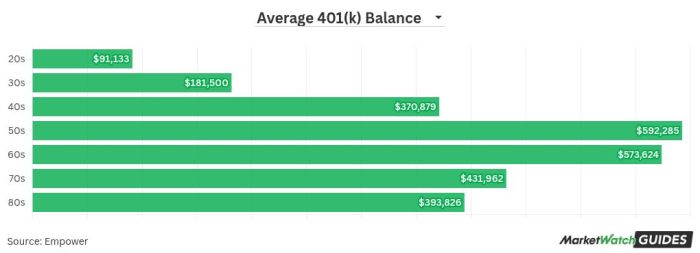
The average 401k balance for 50-year-olds has undergone significant fluctuations over the past few decades, influenced by a mix of economic events and demographic shifts. Understanding these trends is crucial for individuals nearing retirement, as it can impact their financial preparedness and long-term security. In this discussion, we’ll delve into the historical data on average 401k balances for 50-year-olds, exploring the impact of economic events and demographic patterns.Historical Data and Trends – ————————–Over the past four decades, the average 401k balance for 50-year-olds has shown a steady increase, mirroring the growth of the US economy.
However, this growth has been punctuated by significant downturns during recessions, such as the 2008 financial crisis. According to data from the Employee Benefit Research Institute (EBRI), the average 401k balance for 50-year-olds has grown from around $10,000 in the early 1980s to approximately $120,000 in 2020.
Trends During Bull Markets
During periods of economic growth, such as the 1990s and 2000s, 401k balances tend to surge. The EBRI data reveals that average 401k balances for 50-year-olds nearly doubled between 1999 and 2007, as the S&P 500 index more than tripled during this period.
- In 1999, the average 401k balance for 50-year-olds was around $53,000.
- By 2007, this number had increased to approximately $101,000, a growth of nearly 91%.
These gains were largely driven by the strong performance of the stock market, as many 401k plans shifted towards equities during this period.
Trends During Recessions
In contrast, recessions have a profound impact on 401k balances, as investors become increasingly risk-averse and portfolio values decline. The 2008 financial crisis provides a stark example of this effect.
- In 2007, the average 401k balance for 50-year-olds was around $101,000.
- By 2009, this number had declined to approximately $60,000, a loss of nearly 41%.
The sharp decline in 401k balances during recessions underscores the importance of maintaining a diversified portfolio and practicing risk management.
Demographic Differences
A closer examination of demographic trends reveals significant disparities in average 401k balances. Men tend to have higher balances than women, while higher-income individuals enjoy greater wealth accumulation.
- According to the EBRI, in 2020, the average 401k balance for 50-year-old men was around $135,000, compared to $90,000 for women.
- Similarly, individuals with higher incomes tend to accumulate greater wealth, with the EBRI reporting that 50-year-olds in the highest income quartile had average 401k balances of around $180,000, compared to $50,000 for those in the lowest income quartile.
These disparities underscore the importance of promoting financial literacy and education, particularly among underrepresented groups.
Case Studies: Achieving Average 401k Balances for 50-year-olds: Average 401k For A 50 Year Old
In a world where financial security is a top priority, achieving an average 401k balance is a milestone many Americans strive for, especially by the time they reach their 50s. Meet Sarah, a 52-year-old marketing manager who has successfully saved for her retirement, and discover the strategies that set her apart.Sarah started saving aggressively when she was 40, contributing 15% of her income to her 401k plan.
She also took advantage of her company’s matching program, which contributed an additional 3% to her account each month. By the time she turned 50, Sarah’s 401k balance had grown to over $250,000, exceeding the national average for individuals in her age group. She accomplished this feat by consistently reviewing and adjusting her investment portfolio, making sure to rebalance her assets as needed.
The key to Sarah’s success was her disciplined approach to saving, which allowed her to build a substantial nest egg over the years.### Factors Contributing to Success#### Age when Starting to SaveIt’s essential to begin saving early to make the most of compound interest. Sarah started saving at 40, giving her 10 years to build a sizeable nest egg. This head start enabled her to accumulate a substantial balance by the time she turned 50.#### Average Contribution RateConsistently contributing a substantial percentage of income to a 401k plan is crucial for long-term growth.
Sarah contributed 15% of her income, which was above the national average, and her company matched an additional 3%. This higher contribution rate significantly contributed to her overall balance.#### Level of Financial LiteracyUnderstanding how to manage investments, avoid fees, and take calculated risks can make all the difference in retirement savings. Sarah had a good grasp of these concepts and was able to make informed decisions about her portfolio, ensuring her money grew steadily over time.### Commonalities Among Successful SaversWhile everyone’s financial journey is unique, there are several commonalities among individuals who achieve an average 401k balance for 50-year-olds:
Early Start
Consistently saving a significant percentage of income, starting from their 40s or earlier, helped many individuals build a substantial nest egg.
Disciplined Approach
Regularly reviewing and adjusting investment portfolios, avoiding fees, and making informed decisions about risk helped many savers achieve their goals.
Smart Investing
A combination of conservative and growth-oriented investments helped balance risk and potential returns, allowing many individuals to build a substantial retirement fund.Sarah’s experience serves as a valuable lesson: with discipline, consistency, and a solid understanding of financial concepts, it’s possible to achieve an average 401k balance by the time one reaches their 50s.
Navigating Tax Implications for 50-year-olds with Average 401k Balances
As 50-year-olds with average 401k balances begin to retire, they may find themselves facing a complex web of tax implications. Withdrawing from a 401k plan can trigger a tax penalties, tax rates, and required minimum distributions (RMDs), which can significantly impact their after-tax retirement income. In this section, we’ll explore the strategies for minimizing tax liabilities and provide a hypothetical example of how a 50-year-old with average 401k balances might use these strategies to maximize their after-tax retirement income.Tax Penalties for Withdrawal – ————————–Tax penalties for withdrawing from a 401k plan before age 59 1/2 are typically assessed as a 10% penalty.
This penalty can be steep, so it’s essential to understand the rules and plan accordingly.* Withdrawal before age 59 1/2 incurs a 10% tax penalty, in addition to regular income tax.
Exceptions to this rule include taking a series of substantially equal payments, being disabled or terminally ill, or using the withdrawal to pay qualified education expenses.
Tax Rates on 401k Withdrawals – —————————-Tax rates on 401k withdrawals are based on the individual’s income tax bracket at the time of withdrawal. Tax-free growth means that contributions grow tax-free, but the taxes are paid when the money is distributed.* Withdrawals are taxed as ordinary income, with rates ranging from 10% to 37%.
Withdrawals from a traditional 401k plan are subject to income tax.
Required Minimum Distributions (RMDs) – ————————————-RMDs are mandatory withdrawals from a traditional 401k plan starting at age 72. Failure to take RMDs can result in penalties.* RMDs must be taken annually, starting at age 72.
RMDs are taxed as ordinary income.
Strategies for Minimizing Tax Liabilities – —————————————-Several strategies can help minimize tax liabilities when withdrawing from a 401k plan:* Converting a 401k to an IRA or annuity: By converting a traditional 401k plan to an IRA or annuity, individuals can potentially reduce tax liabilities by spreading the taxes over time.
Tax-loss harvesting
Harvesting tax-losses by selling investments with losses can offset gains and reduce tax liabilities.
Using tax-deferred growth
By using tax-deferred growth, individuals can delay paying taxes on their 401k investments, allowing their savings to grow tax-free for a longer period.Case Example: Maximizing After-Tax Retirement IncomeMeet Jane, a 50-year-old with $200,000 in her 401k plan. Jane expects to retire in 5 years and wants to maximize her after-tax retirement income. To minimize tax liabilities, Jane decides to convert her traditional 401k plan to an annuity, which will provide her with a steady income stream in retirement.* By converting her 401k to an annuity, Jane can potentially reduce her tax liabilities by spreading the taxes over time.
- Jane can also use tax-loss harvesting to offset gains and reduce tax liabilities.
- By using tax-deferred growth, Jane can delay paying taxes on her 401k investments, allowing her savings to grow tax-free for a longer period.
Through these strategies, Jane can potentially improve her after-tax retirement income and enjoy her golden years without financial stress.
Visualizing Average 401k Balances for 50-year-olds

Visualizing the average 401k balances for 50-year-olds can provide a comprehensive understanding of how Americans are preparing for retirement. According to recent data from the Investment Company Institute, the average 401k balance for Americans in their 50s is approximately $244,000. This figure raises concerns about the adequacy of retirement savings among this demographic.
Design of the Average 401k Balances Table
Below is a table comparing average 401k balances for 50-year-olds in different regions of the country. This data is based on publicly available information from the Employee Benefit Research Institute (EBRI) and the Pension Institute.
| Region | Average 401k Balance (2023) |
|---|---|
| Northeast | $279,000 |
| Pacific Northwest | $294,000 |
| Southeast | $234,000 |
| Midwest | $251,000 |
| Northern Plains | $266,000 |
Methodology for Calculating Average 401k Balances
The methodology used to calculate the average 401k balances involves collecting data from publicly available sources such as the EBRI and the Pension Institute. The data is then aggregated to determine the average balance by region. It’s essential to note that these figures may not reflect the individual experiences of 50-year-olds, as they are based on aggregate data.
Implications of Average 401k Balances for Retirement Planning
Understanding the average 401k balances among 50-year-olds emphasizes the need for increased awareness and preparation for retirement. Many Americans in this age group may not have saved enough to maintain their pre-retirement lifestyle. These statistics highlight the importance of starting early and consistently saving for retirement.
Case Study: Regional Variations in Average 401k Balances
A closer examination of the table reveals that the Pacific Northwest region has the highest average 401k balance of $294,000. In contrast, the Southeast region has the lowest average balance of $234,000. These regional variations underscore the importance of considering geographic factors when planning for retirement.
Awareness and Preparation for Retirement, Average 401k for a 50 year old
The average 401k balances among 50-year-olds underscore the need for increased awareness and preparation for retirement. By understanding these statistics and taking proactive steps to save for retirement, individuals can reduce their financial uncertainty and improve their overall well-being in their post-work years.
Increasing Awareness of Retirement Readiness
To address the issue of inadequate retirement savings among 50-year-olds, it’s essential to increase awareness of retirement readiness. Educational programs and resources can help individuals develop effective retirement savings strategies and understand the importance of planning for the future.
Strategies for Increasing Retirement Savings
To increase retirement savings, individuals can implement the following strategies:
- Develop a comprehensive retirement plan, including projections for income and expenses in retirement
- Maximize contributions to their 401k or other retirement accounts
- Consider catch-up contributions to accelerate savings
- Take advantage of tax-advantaged accounts such as Roth IRAs
- Diversify retirement savings across different asset classes and investments
Conclusion
The average 401k balances among 50-year-olds raise concerns about retirement readiness and highlight the need for increased awareness and preparation. By understanding these statistics and implementing effective strategies, individuals can improve their financial security and well-being in their post-work years.
FAQs
What is the average 401k balance for a 50-year-old in the United States?
According to recent data, the average 401k balance for a 50-year-old in the United States is approximately $240,000.
How often should a 50-year-old contribute to their 401k plan?
Aiming to contribute at least 10% to 15% of their income towards their 401k plan is recommended for most 50-year-olds, with the goal of maximizing their retirement savings.
Can a 50-year-old withdraw from their 401k plan early without penalty?
Yes, a 50-year-old may withdraw from their 401k plan early, but it is subject to a 10% penalty unless an exception applies, such as separation from employment or financial hardship.
What is the optimal investment strategy for a 50-year-old?
A diversified investment portfolio with a mix of low-risk, medium-risk, and high-risk assets, such as stocks, bonds, and real estate, can help 50-year-olds achieve their retirement savings goals.
